Sunday, 17 March 2013

Place of Battle


In the days when the population around the Mediterranean was too small to make an impact and there was no rampant Japanese market the Mediterranean Sea had vigorously healthy tuna stocks. The fish would enter the Straits of Gibraltar in late spring and fill larders from Andalucia to Sicily and beyond. On the coast of Catalonia tuna fishing was an activity in which whole communities would participate. Villages were often built slightly inland on raised ground but when the tuna came the population would decamp to the beach and set up shop for the duration.

The method of fishing was called 'Almadrava'* and the technique was as follows. At a chosen beach a net would be set diagonally with respect to the land, with one end fixed to the sand and the other rowed out to sea and anchored. The fast swimming fish, entering the net, would find themselves forced ever nearer the beach until they reached the inevitable cul-de-sac. Here the villagers would wade in with harpoons while others in boats would attack the fish from behind. The word 'Almadrava' comes from Arabic and means 'place of battle'. Almadrava fishing was nothing short of a massacre. The moment of thrashing silver fish, wild water, sunlight, bronzed limbs and gushing blood is vividly depicted in Salvador Dalí's 'la pesca del atún' (Tuna fishing) painted on the Costa Brava over the summers of 1966 and '67 and capturing on canvas one of the last seasons of almadrava fishing.


Almost all of this abundant harvest of tuna would be conserved in olive oil. Originally in glass jars and later in tins. The fish tripe, salted and dried, would sustain the population over the winter. Nowadays, while you can buy tuna flesh in tins very cheaply and indeed, it's not enormously expensive even fresh, the dried tripe, tasty though it is, commands a price far beyond its worth. But such is the madness of the world we have made for ourselves.

*In Southern Spain tuna is still fished with a method called 'almadraba' (note the b rather than v that distinguishes the Catalan). The Andulucian almadraba is set at sea, as opposed to from the beach, the nets forming a maze that leads the fish to a central area. Boats converge and a net floor is raised bringing the tuna to the surface where they are killed and hauled aboard. Again it is a place of battle.  

Monday, 11 March 2013

A load of bull


 Local Catalan fisherman's food at its most traditional is tuna tripe. Salted and sun-dried in the style of salt cod it can been seen swinging in the breeze outside restaurants, as much to continue the drying as to advertise that fish tripe is on the menu. Like other foodstuffs once eaten only by fishermen tuna tripe, known as 'bull' in Catalan has become fashionable—at least in Catalonia—and now costs around 60 euros per kilo, if you can find it at the market.


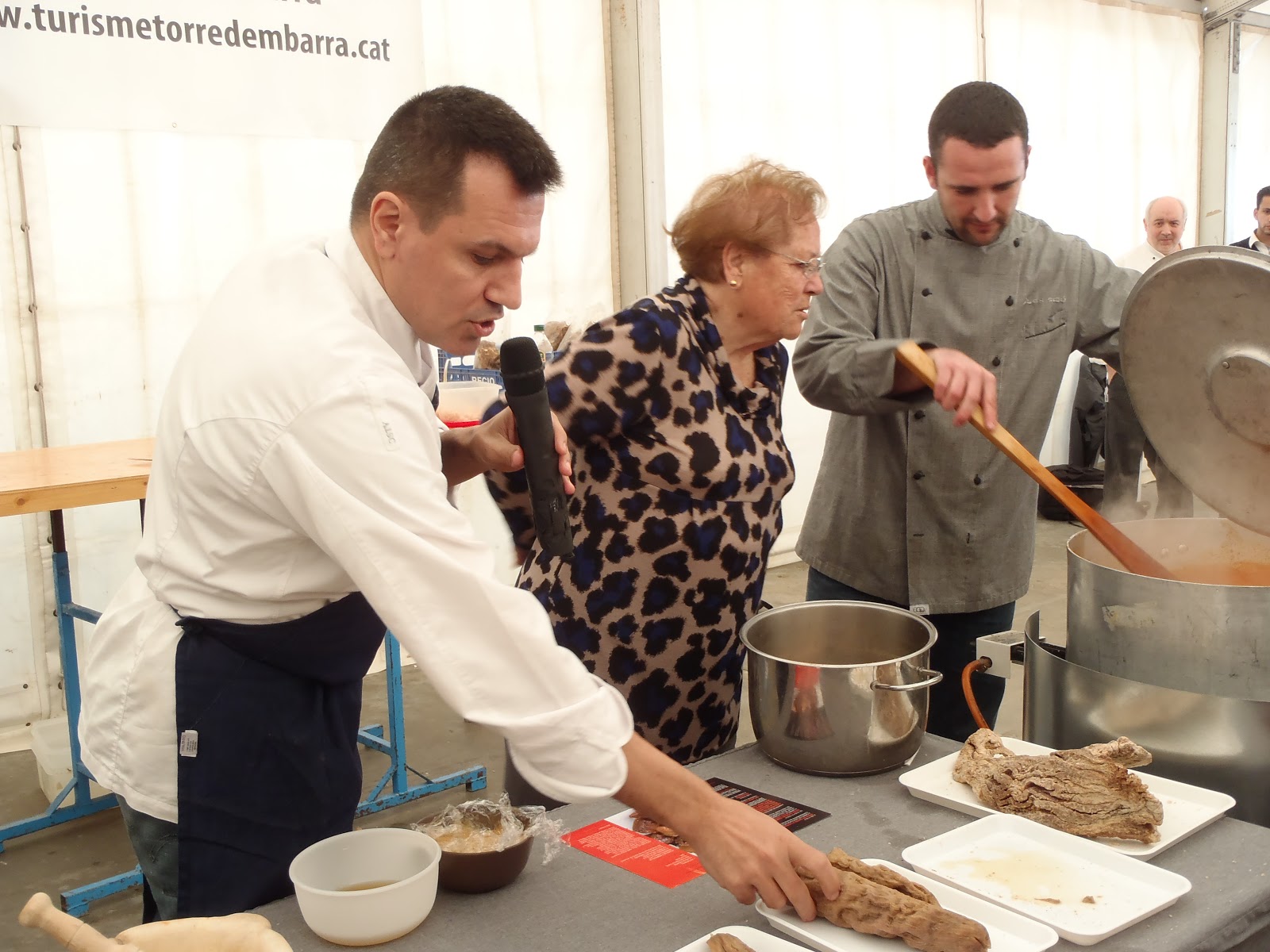
The town of Torrdembarra considers itself the capital of 'bull' cusine and once a year holds a tasting day in which a pair of chefs cook various tapas which, for three euros per tapa (wine included), can be tried by the hungry public. For quite a few years I've queued up for my yearly dose of 'bull'.  


 This year the cooks involved were Oriol Castro of the Bulli foundation, Alex Segù from nearby restaurant Mulsum and, star of the show Iris Figuerola, fisherman's wife and renowned expert on all things 'bull' who demonstrated her 'bull al romesco', a stew made on a thick paste of almonds, dried peppers, garlic and fried bread, stock, tripe and potatoes.

 In go the spuds


Stomach or offal of any sort and of any animal tends to be an aquired taste and hard to err, stomach by the unconverted and 'bull' is no different. One woman I spoke to, who hasn't eaten it since she first tried it many years ago, said it tasted of urine. My opinion is a bit more generous. 'Bull' tastes vaguely of tuna with a more general and pervading fishy flavour underneath. What makes it more unusual, apart from its provenance, is its pleasantly spongy texture. But for me what heightens the pleasure of eating this offbeat foodstuff is its history. Knowing that this was the hard tack that sustained men on the sea makes all the difference. 

A foodstuff that hasn't yet become fashionable and which is usually discarded or kept back for personal consumption by the fishmonger is monkfish liver. As there is no demand for monkfish liver I can pick up this tasty and nourishing food for free, which means I can afford a few 'gambas' to go with it.


  1. Monkfish liver, prawns, fried garlic and Malden salt.

Monday, 25 February 2013

Octopus

 Octopuses have appeared a few times on this blog in a metaphorical role. But as well as playing the part of symbolic monster of the deep and representing fear on and off the water, they also feature in my kitchen.

 These eight armed cephalopod molluscs are fascinating creatures and over the next few months I hope to upload several posts about them. Before going into details though, I wanted to show these photos. That the octopus is a beautiful creature in the sense that all living beings are possessed with beauty goes with out doubt, however the octopus also harbours the kind of aesthetic harmony that in another context would merit a design award.
I caught this octopus over the summer (I never buy them) and, after six months in the freezer, cooked it up the other day. Preparing an octopus for the table is a three part process (again more on this at a later date) and these photos show stage two, the creature having been boiled in water for 90 minutes.  


Wednesday, 13 February 2013

Winter waves


On the Mediterranean coast the wind has been winter's trade mark element, howling round the houses, wrenching tiles from roofs, sculpting the dunes, polishing the sky and combing  wave crests in to high bouffant quiffs. After years of observing the show, patterns emerge, familiar waves types particular, I suppose, to all shores with generally tideless waters, shallow sandy bottoms and limited fetch.


But what never ceases to fascinate is that for all the similarities no two waves are ever the same. Herein seems to lie the key to some profound reflection on life and the universe but due to feeble intellectual powers it remains forever just out of reach.


Wednesday, 6 February 2013

The Beach Bar


The tale of storing Onawind Blue on land is lengthy and tiresome. Causing angst in various degrees she's lived in the communal garden, under a bridge, on some wasteland padlocked to a chain-link fence and in a passage way leading to the beach. Briefly she was an honorary member of the local sailing club. But her minor fame, uniqueness and stunning looks weren't sufficient to conserve her place on the sand and when a motion for her to pay up or move on was seconded she was hoisted onto her sorry trailer and trundled on the streets once more. 


However, the opportunity to build, open and run a beach bar at the same club arose. I dug out all those bits of driftwood and rope I'd been saving for years, built the bar, furnished and stocked it and then, needing an iconic centrepiece, rolled OB back in from the street, washed off the grime and set her up with spotlights inside illuminating the masts against the night skies.

And so while I poured beers, peeled potatoes, grilled fish, flipped pancakes and mixed G&Ts she spent the summer being decorative. Her hull remained dry for months but she was under my wing and at busy moments I would shoot her a glance and feel her calming presence.

It wouldn't be true to say that I built and ran a bar and worked myself to the bone all for my boat but for the sake of romance lets say that it is.


Thursday, 31 May 2012

The Invisible Workshop again


 The local sailing club has some very tired Optimists that, after 12 years without maintenance, have become unseaworthy. Wanting to keep children alive while teaching them to sail the club asked The Invisible Workshop if some renovation work could be done. 


 I chose the one in worst condition first. Looking back on the hours of work it would have been more economical to scupper the boat, had I not given a ridiculously low quote. The more of the rotten and broken fibreglass I cut away the more I knew I’d have to rebuild. But keeping those kiddies in mind I plugged on and was pleased with the results.


Friday, 27 April 2012

The last bit, at last


OB came through the gybe on the inside and I looked back at the other boats feeling rather guilty for employing aggressive tactics. The wind, however, wouldn’t let me dwell on ethics. What had seemed like a fresh following breeze now appeared to be half a gale as we sailed to windward. Even double reefed OB was over pressed and unbalanced, I could only ease the heavy weather helm by completely sheeting out the mizzen sail and raising the daggerboard by half. The main I kept in good and taut and OB sailed at her maximum angle of heel.

I felt confident about driving OB hard. The wind was solid and, away from the land, the gusts came on more gently. I had my legs hooked under an oar lashed across the thwarts and my bum hanging over the rail. My boat was making good progress to windward compared to others further to leeward, some of whom appeared to be over canvassed and spilling wind.

Coming up to the next mark—OB throwing up a deal of spray and riding on a wave of foam—the race boat approached. The organiser, now wearing the hat of race official shouted across. He might have been imparting important information or quoting Cervantes, whatever, the words were lost to the wind. I watched the zodiac whizz off towards other boats.

I tacked OB round the windward mark and she hared off on the second downwind leg.

Looking around I saw that we were alone. I had almost certainly missed some vital information. Reflecting, I reckoned there was nothing for it but to crack on regardless—even if I had messed up it had been an enormously enjoyable sail.

On the long beat back towards the beach I began to see other boats again. But I couldn’t quite work out what they were doing. None were in the buoyed channel that led to beach, most were off downwind in amongst the moored craft. As the beach came into view I could see that it was deserted, I really had got this very wrong. I tacked a couple more times in the calm water in front of the town and let OB waft up to the sand.

In and around the beach bars people were clapping, applauding something out of sight behind me. I pulled OB’s bows onto the sand and lowered the sails. When I looked up from this task I found a knot of people had gather around and as I acknowledged them they congratulated me. OB had won.

Before this fully registered however, another boat arrived at the beach, the captain and crew immediately informing me that I had passed the first windward mark to port rather than to starboard. As such, they reasoned, I hadn’t followed the course. They were right I had gone to port, damn and drat it. Oh well. More boats arrived and eventually the zodiac and Quico, the organiser/official. The case was put to him.

 ‘What course did you sail exactly.’ Asked Quico.
 Twice round the windward and leeward marks, I explained.
‘Ha!’ he laughed, ‘Didn’t you hear me shouting that it was too windy to do two laps and that you should head back to the beach after completing one?’

That news spread and the next thing I knew I was being congratulated again. Everyone seemed to agree that sailing double the distance and still arriving first merited a prize.

I didn’t attend the prize giving dinner that evening however. I was keen to lap up the glory but I’d found a beautifully sheltered spot to anchor OB and I didn’t feel like an overland trek to the venue or a long row into headwinds. When someone called and offered to come and collect me by car I found myself refusing. In truth I just wanted to enjoy my last night aboard OB, tomorrow I’d be going home on the train to collect the car and trailer, it would be a long hot day. No, tonight was for me and my boat. I lay back, looked up at the stars and pondered on rigs that can be well and effectively reefed, unballasted craft that respond well to crew weight and the importance of sheeting in properly when sailing to windward.